Options
The “Oriental” Book Trade in the Late Nineteenth and Early Twentieth Centuries: An International Workshop
Date
2027-04-29
Abstract
Call for Proposals
The “Oriental” Book Trade in the Late Nineteenth and Early Twentieth Centuries: An International Workshop
Convenors: Vincent Engelhardt (Hamburg University) & Sabine Schmidtke (Institute for Advanced Study, Princeton, NJ)
Date and Venue: Centre for the Study of Manuscript Cultures (CSMC), University of Hamburg, 29-30 April 2027
The expansion of Oriental Studies beyond the Middle East, together with the spread of the printing press within the region, created a growing demand for manuscripts and printed books in Arabic, Persian, Ottoman Turkish, and related languages across North Africa, West Asia, Europe, the United States, and Russia in the late nineteenth and early twentieth centuries. In response, the number of book traders grew considerably. Some operated from Europe—among them Otto Harrassowitz, S. Calvary & Co., and Paul Haupt—while others were based in the Middle East, such as Isaac Benjamin Yahuda, Muhammad Amin al-Khanji, Farajallah Zaki al-Kurdi, and Riza Nasrullah.
These two groups worked in close interdependence. Western traders generally relied on partners in the region, while their Middle Eastern counterparts depended on intermediaries who could correspond with Western institutions and sustain ties to the academic world beyond the Middle East. Many Middle Eastern traders also operated printing presses and dealt in manuscripts—activities that some Western traders shared as well.The workshop foregrounds the activities of these book traders at the intersection of manuscripts and printed books. It ultimately questions the very distinction between handwritten and printed books at the time.
This workshop invites case studies of such publishers, traders, and intermediaries, examining their networks, business practices, and/or contributions to the transregional circulation of knowledge. We welcome contributions from scholars at all career stages and from a range of disciplinary perspectives. We intend to publish a selection of the papers in a peer-reviewed volume, and we encourage contributors to prepare their work with eventual publication in mind.
Submission details
Please send an abstract of no more than 400 words, together with a short biographical note (approximately 100 words), to [email protected].
Deadline for proposals: 30 October 2026
Notification of acceptance: by 30 November 2026
The working language of the workshop is English.
A limited amount of funding is available to support travel and accommodation for participants who require it; please indicate any such need when you submit your proposal.
The “Oriental” Book Trade in the Late Nineteenth and Early Twentieth Centuries: An International Workshop
Convenors: Vincent Engelhardt (Hamburg University) & Sabine Schmidtke (Institute for Advanced Study, Princeton, NJ)
Date and Venue: Centre for the Study of Manuscript Cultures (CSMC), University of Hamburg, 29-30 April 2027
The expansion of Oriental Studies beyond the Middle East, together with the spread of the printing press within the region, created a growing demand for manuscripts and printed books in Arabic, Persian, Ottoman Turkish, and related languages across North Africa, West Asia, Europe, the United States, and Russia in the late nineteenth and early twentieth centuries. In response, the number of book traders grew considerably. Some operated from Europe—among them Otto Harrassowitz, S. Calvary & Co., and Paul Haupt—while others were based in the Middle East, such as Isaac Benjamin Yahuda, Muhammad Amin al-Khanji, Farajallah Zaki al-Kurdi, and Riza Nasrullah.
These two groups worked in close interdependence. Western traders generally relied on partners in the region, while their Middle Eastern counterparts depended on intermediaries who could correspond with Western institutions and sustain ties to the academic world beyond the Middle East. Many Middle Eastern traders also operated printing presses and dealt in manuscripts—activities that some Western traders shared as well.The workshop foregrounds the activities of these book traders at the intersection of manuscripts and printed books. It ultimately questions the very distinction between handwritten and printed books at the time.
This workshop invites case studies of such publishers, traders, and intermediaries, examining their networks, business practices, and/or contributions to the transregional circulation of knowledge. We welcome contributions from scholars at all career stages and from a range of disciplinary perspectives. We intend to publish a selection of the papers in a peer-reviewed volume, and we encourage contributors to prepare their work with eventual publication in mind.
Submission details
Please send an abstract of no more than 400 words, together with a short biographical note (approximately 100 words), to [email protected].
Deadline for proposals: 30 October 2026
Notification of acceptance: by 30 November 2026
The working language of the workshop is English.
A limited amount of funding is available to support travel and accommodation for participants who require it; please indicate any such need when you submit your proposal.
Description
Call for Proposals: The “Oriental” Book Trade in the Late Nineteenth and Early Twentieth Centuries: An International Workshop
Convenors: Vincent Engelhardt (Hamburg University) & Sabine Schmidtke (Institute for Advanced Study, Princeton, NJ)
Date and Venue: Centre for the Study of Manuscript Cultures (CSMC), University of Hamburg, 29-30 April 2027
Convenors: Vincent Engelhardt (Hamburg University) & Sabine Schmidtke (Institute for Advanced Study, Princeton, NJ)
Date and Venue: Centre for the Study of Manuscript Cultures (CSMC), University of Hamburg, 29-30 April 2027
File(s)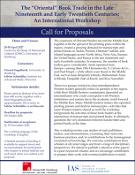
Loading...
Name
CFP_Oriental Book Trade_April 2027.pdf
Size
1.26 MB
Format
Adobe PDF
Checksum (MD5)
bb8449291feb5cae380f4dc7c1d50890