Options
Systems of Division for the New Testament Gospels in Greek, Syriac, Coptic, and Arabic Manuscripts and Their Hermeneutic Significance
Date
2026-03-17
Author(s)

Abstract
Throughout the history of Christianity, various systems have been used to divide the text of the New Testament Gospels. The oldest systems originated in Late Antiquity and were developed in the Greek manuscript tradition. Examples include the Eusebian cross-reference system, the divisions attested in Codex Vaticanus, and chapters first attested in Codex Alexandrinus. Once the New Testament Gospels were transferred into new cultural spheres and languages, elements of some old systems were preserved or adapted while new ones were introduced. The analysis of the various systems of division in the Syriac, Coptic, and Arabic manuscript traditions is still in its infancy. During the panel workshop, we will present examples of some of the most widely attested division systems in these manuscript traditions, focusing on manuscripts with the continuous text of the New Testament Gospels (or some of them).
Description
Systems of Division for the New Testament Gospels in Greek, Syriac, Coptic, and Arabic Manuscripts and Their Hermeneutic Significance
A panel workshop with Jeremiah Coogan (JST-SCU/Berkeley; IAS), George A. Kiraz (IAS), Sabine Schmidtke (IAS), and Sofía Torallas Tovar (IAS)
(17 March 2026, 12–2 pm, Rubenstein Commons 1)
A panel workshop with Jeremiah Coogan (JST-SCU/Berkeley; IAS), George A. Kiraz (IAS), Sabine Schmidtke (IAS), and Sofía Torallas Tovar (IAS)
(17 March 2026, 12–2 pm, Rubenstein Commons 1)
File(s)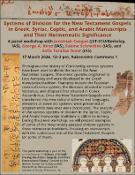
Loading...
Name
Poster.pdf
Size
640.04 KB
Format
Adobe PDF
Checksum (MD5)
98a1044668e03a7e2435c06d11414430